
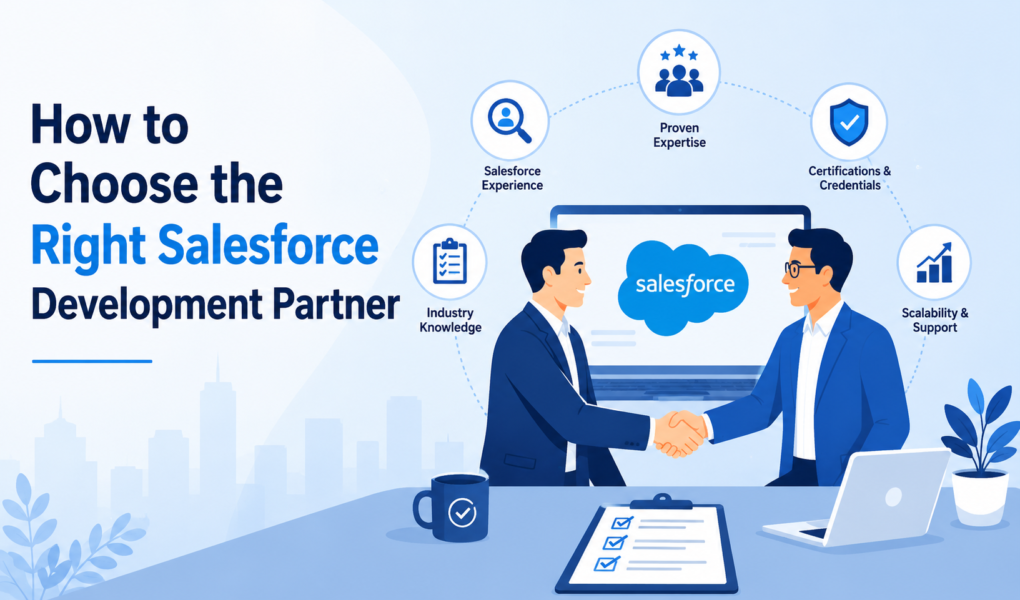
Businesses aren’t just talking about CRM automation and AI, they’re all in. Everybody wants sharper customer insights and seamless digital tools. Salesforce is keeping pace, churning out fresh AI features, pumping up Data Cloud, launching Agentforce, and rolling out solutions tailored for different industries.Choosing a Salesforce Development Partner isn’t just a box to check off. It’s a big deal for your business.
If you end up with the wrong partner, get ready for slow projects, tangled integrations, security issues, and a team that dreads using the platform. But when you pick the right one, everything runs smoother. Processes flow better, customers stick around, and you finally start seeing a real payoff for what you’ve spent on Salesforce.
By 2026, nobody’s hunting for basic “Salesforce implementers.” Teams need true partners, people with real ideas, automation know-how, the ability to scale, and the guts to challenge the old way of doing things.
This guide keeps the fluff to a minimum and helps you spot and choose the best Salesforce Development Services provider for your business.
Why Your Salesforce Partner Choice Matters
Let’s not sugarcoat it, Salesforce projects have gotten complicated. People are connecting Salesforce with their ERP, their marketing tools, customer service, AI, payments…the list just keeps growing.
A real Salesforce Development Agency isn’t just “some developers.” They help map your processes, plan CRM architecture, set up integrations everywhere, automate workflows, implement AI, get security sorted, build custom Lightning components, and keep supporting you as you grow.
Pick the wrong team? You’ll get messy systems, lousy user adoption, and expensive rewrites.
How to Choose the Right Salesforce Development Partner
1. Check Their Actual Salesforce Expertise
Not all agencies are the real deal. Some just add Salesforce to a laundry list of services and barely scratch the surface. When you’re reviewing candidates, look for:
– Real Salesforce certifications
– Number of completed Salesforce projects
– Experience in your industry
– Hands-on work across different Salesforce Clouds
– Automation and integration chops
You need a team of certified experts, developers, architects, consultants, who truly understand Sales Cloud, Service Cloud, Marketing Cloud, Experience Cloud, Commerce Cloud, Data Cloud, and Agentforce AI tools. Honestly, AI-powered automation is everywhere now; it’s expected, not impressive. So work with people who genuinely know their stuff.
2. Check Their Industry Experience
It’s cool if they know Salesforce inside and out, but do they understand your world? Healthcare companies need HIPAA-compliant setups. Finance firms obsess over compliance and security. E-commerce lives and dies by seamless, omnichannel integration. SaaS cares about smooth RevOps. Manufacturing looks for transparency in their supply chain.
A Salesforce Development Company that’s already walked your path will get what you’re facing. You’ll deal with fewer headaches and see faster, more accurate solutions.
Always ask for case studies from clients in your own industry.
3. Look for Custom Development Skills
Nobody runs vanilla Salesforce anymore. You might need custom Lightning components, unique AppExchange apps, tricky integrations, sharp dashboards, AI automation, CPQ tweaks, or tight mobile app connections.
See if their team handles Apex, Lightning Web Components, Visualforce, REST/SOAP APIs, MuleSoft, and Salesforce DevOps. Don’t settle for a one-size-fits-all approach. Look for a team ready to keep your stack future-proof.
4. Examine Their Project Delivery Style
Project management makes or breaks these projects. Ask how they handle:
– Gathering requirements
– Sprint planning
– Communication and QA
– Documentation, deployment, and change management
Top teams use Agile, keep you posted with real-time dashboards, run tight sprint reviews, and stick to clear frameworks.
Really dig in:
– How do they estimate timelines?
– What’s the process when things go off track?
– How is scope defined?
– How do they manage risk?
You’re looking for transparency, so you’re not blindsided later.
5. Watch Their Communication
Even rockstar developers can mess things up with bad communication. Your Salesforce partner should:
– Send useful, regular updates
– Keep documentation tidy
– Give you a single point of contact
– Respond quickly to requests
– Translate technical jargon into normal language
Notice in early calls, are they quick and clear? Are they giving off a sense they’ll actually look out for you?
6. Check Their Integration Track Record
Let’s not kid ourselves: everyone’s business systems are tangled now. Your Salesforce probably needs to link up with SAP, HubSpot, Shopify, QuickBooks, Microsoft Dynamics, Slack, payments, ERP, and more.
Screw up integration and you’re stuck with data silos, manual work, and terrible reports.
You want a partner who knows API architecture, middleware, syncing data, clean migrations, and rock-solid security. Ask for war stories, they should have real examples.
7. Think About Scalability and Long-Term Support
Your needs today aren’t your needs next year. Don’t pick the cheapest shop on the block—they’re seldom ready for real growth.
Good Salesforce partners stick around. They tune performance, add features, train your team, and keep your stack safe. Partnerships like this help your company stay strong and flexible as you scale up.
8. Check Official Salesforce Credentials
Salesforce ranks its partners by experience, certifications, and customer success. Don’t forget to look at their partner status, credentials, real customer reviews, their portfolio, and any awards.
But don’t obsess over tier. Sometimes the smaller, focused teams deliver more attention and better results.
9. Read Those Reviews
What do past clients actually say? Watch for feedback about communication, delivery speed, technical skills, post-launch support, and how they handled surprises.
Scan reviews on Clutch, G2, AppExchange, Google, or LinkedIn. Patterns, positive or negative, usually repeat.
10. Gauge Their AI and Automation Game
By 2026, Salesforce is all about automation and AI. Teams need help with lead scoring, self-serve customer support, smarter forecasts, automated workflows, predictive analytics, and intelligent reporting.
You need a partner who’s fluent in Einstein AI, Agentforce, Data Cloud, AI governance, and workflow orchestration. If they’re not up to speed, you’ll fall behind, fast.
Must-Ask Questions
Before you shake hands, get direct answers:
Technical:
– Which Salesforce products do you really know?
– How many certified people are on your team?
– What’s your best integration story?
Business:
– Have you worked in our industry with our kind of challenges?
– How do you measure project success?
– How do you boost user adoption?
Operations:
– What tools keep communication flowing?
– Who leads the project?
– How do you handle delays or scope changes?
Support:
– Are you around after launch?
– How fast do you reply when something breaks?
– Can you grow with us?
The way they answer speaks volumes about their skills and their attitude.
Common Mistakes
– Don’t just go for the lowest price. Cheap ends up costing more down the line.
– Don’t ignore industry know-how. Salesforce skills alone aren’t enough.
– Don’t overlook growth potential. Make sure they can scale with you.
– Don’t wander in without clear business goals.
– Don’t skip technical checks. Always verify certifications and real-life outcomes.
What a Good Salesforce Partner Looks Like
The right agency gets your business and where you want to go. They bring strategic ideas, not just code. They tell you if things go wrong, and how to fix them. They design solutions you can actually scale. They back up their tech talk with real skill. They care about your long-term success, not just a quick sale. And their documentation and security are top-notch.
A strong partner acts like an advisor, not just a contractor.
Final Thoughts
When searching for the Salesforce Development Partner in 2026, it is important to consider not only price issues. It is essential to look for the companies that possess experience in AI automation, integration, CRM architecture, and other customer needs. Having such partners in technology will help you boost the performance of your business and prepare for digitalization in the future.
Dean Infotech and similar organizations are making significant investments in the sphere of Salesforce development and AI-enabled services. With the help of those services, clients may acquire competitive advantages in a dynamically changing environment. The ideal Salesforce Development Company should combine its technical and strategic approaches by creating an ecosystem of CRM that will benefit in the future.
The selection of a Salesforce Development Company will greatly affect the effectiveness of the processes and ROI as they may range from Salesforce deployment to AI integration. Besides costs, it is also important to take into account such factors as scalability, communication, and delivery capabilities of the partner.
The Salesforce Development Company should be not only a supplier of Salesforce services but also your partner for future success.